Esports gaming culture: 7 major championship trends
Competitive gaming exploded into the mainstream consciousness during 2025 and frankly the scale of what happened surprised even seasoned esports observers. The global esports audience reached 640.8 million viewers by the end of the year while the industry generated 1.79 billion dollars in revenue representing a 16.2 percent increase from 2024. These aren’t niche numbers anymore. Esports carved out legitimate status alongside traditional sports entertainment through championship tournaments that drew millions of concurrent viewers and prize pools exceeding billions of dollars combined
The esports gaming culture championships and trends exploded into the mainstream consciousness during 2025. Frankly, the scale of what happened surprised even seasoned observers, as the global esports audience reached 640.8 million viewers by the end of the year. This industry, generating 1.79 billion dollars in revenue, has carved out a legitimate status alongside traditional sports through championship tournaments that drew millions of concurrent viewers. Understanding this evolution requires examining the dominant games, historic wins like T1’s dynasty, and the regional dynamics shaping the future of competitive gaming
What makes 2025 historically significant is how esports transitioned from emerging entertainment to established sporting infrastructure. Major media networks and traditional sports brands invested heavily in competitive gaming recognizing that younger demographics aged 18-34 comprised 52 percent of the American esports audience. Generation Z leads globally accounting for 43 percent of all esports viewers. These audiences don’t passively consume gaming content. They actively participate in online communities attend live events and influence mainstream culture through streaming platforms that reach hundreds of millions daily.
The championship landscape expanded dramatically across multiple titles and regions. League of Legends maintained dominance with peak viewership reaching 3.4 million concurrent viewers at the 2025 Mid-Season Invitational finals. Counter-Strike 2 dominated Q1 2025 with 99.16 million hours watched on Twitch demonstrating how tactical shooters reshaped competitive gaming preferences. T1 cemented legendary status by winning their third consecutive League of Legends World Championship becoming esports’ most decorated organization in the modern era.
The business fundamentals reflected this mainstream acceptance. Sponsorships and media rights accounted for 65 percent of total esports revenue while mobile esports grew at a staggering 27.6 percent annual rate. Professional gamers saw average salaries rise from 110,000 dollars in 2024 to 138,000 dollars in 2025 with top players in established regions earning multiples of that baseline. The Esports World Cup 2025 distributed 71.5 million dollars in prize money representing the largest combined prize pool in esports history.
Understanding esports in 2025 requires examining five core dimensions: the dominant games reshaping competitive preferences the historic championships redefining what excellence means regional dynamics creating distinct competitive cultures professional tournament infrastructure and the business fundamentals driving billion-dollar industry expansion.
Esports gaming culture and top streaming games
the streaming platform wars reached new intensity during 2025 as different games found their audiences across competing platforms and regions. the narrative shifted from League of Legends maintaining universal dominance to a fragmented ecosystem where multiple titles claimed regional supremacy and specific platform leadership.
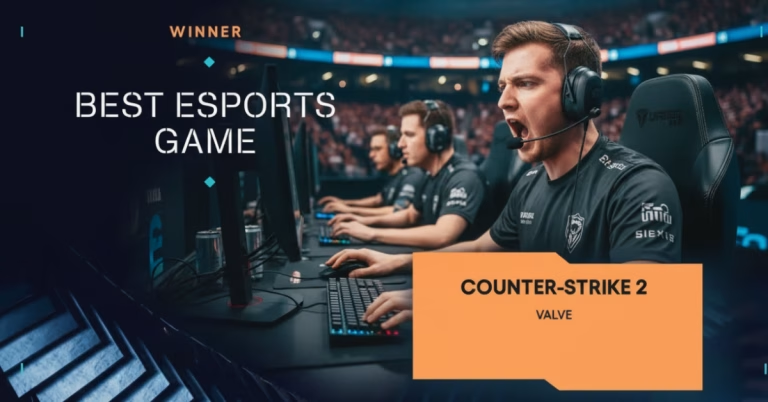
Counter-Strike 2 completed its remarkable ascent during Q1 2025 by claiming 99.16 million hours watched on Twitch. this represented genuine momentum against League of Legends which accumulated 78.4 million hours watched during the same period. the competitive narrative explained itself when examining tournament schedules. CS2 packed five S-tier events into the first three months including IEM Katowice which peaked at 937,876 concurrent viewers. the round-based format creates natural tension that sustains viewer engagement across extended broadcasts. when tournaments run continuously without dead weeks between majors audiences develop watching habits that episodic competition simply cannot replicate.
by January 2025 Counter-Strike 2 maintained average viewership of 80,400 concurrent viewers with monthly hours watched exceeding 59.5 million. this consistency matters more than occasional peaks when measuring advertiser value and platform relevance. yet League of Legends refused to fade. the game hit peak viewership of 1.9 million concurrent viewers during major tournaments and maintained its position as the globally most-viewed esport with 6.94 million peak viewers across all platforms.
the platform breakdown revealed fascinating regional preferences. Twitch prioritized tactical shooters and PC-focused games with Counter-Strike League of Legends Dota 2 Valorant and Rainbow Six Siege dominating the top five. YouTube told a completely different story where Mobile Legends Bang Bang led with 42.67 million hours watched followed by League of Legends at 52.56 million hours and Counter-Strike at 40.03 million hours. this split demonstrates how geographic distribution shapes competitive gaming. Southeast Asian audiences on YouTube drove Mobile Legends to over 3 million peak concurrent viewers making it the world’s most watched esports title in 2025.
Valorant established itself firmly in the third tier of viewership with 47,601 active streamers and average daily viewers of 48,726. the agent-based shooter format attracts players seeking more strategic depth than pure mechanical aim duels. Riot’s franchise investment in the Valorant Champions Tour and regional leagues created sustainable viewership outside traditional tournament windows.activeplayer
| GAME | Q1 2025 HOURS WATCHED | AVG CONCURRENT VIEWERS | PEAK CONCURRENT | PRIMARY STRENGTH |
| Counter-Strike 2 | 99.16M | 80,400 | 937,876 | Twitch dominance |
| League of Legends | 78.4M | 144,000 | 1.9M | Global consistency |
| Dota 2 | 59.1M | 38,476 | Specification TBD | Hardcore audience |
| Mobile Legends | 50M EWC | 3M+ | Record viewership | YouTube/Asia dominance |
| Valorant | Not disclosed | 48,726 | 626,241 | Franchise stability |
Fortnite maintained relevance through innovative tournament formats. the FNCS 2025 Pro-Am delivered 644,000 peak concurrent viewers and 2.3 million hours watched during a five-hour broadcast. the Pro-Am format pairing professional players with popular content creators proved effective at attracting diverse audiences beyond hardcore competitive fans. this demonstrated that esports viewership extends beyond pure competition into personality-driven entertainment.
the streaming platform distribution during 2025 showed YouTube overtaking Twitch for certain titles. League of Legends events peaked at nearly 2 million concurrent viewers on YouTube compared to 800,000 on Twitch. this shift reflects how content distribution evolved as publishers negotiated exclusive broadcast deals and optimized for different platform algorithms.
geographic viewing patterns heavily influenced these numbers. North America and Europe drove Counter-Strike 2’s Twitch viewership while League of Legends showed balanced global distribution. LCK matches from Korea and LPL broadcasts from China generated millions of hours watched even when western audiences slept. the rise of co-streaming also fragmented reported numbers. popular streamers watching and commenting on major tournaments created multiple viewing options that official broadcast metrics didn’t fully capture. the fundamental lesson from 2025 streaming trends was that tournament frequency and strategic scheduling matter as much as game quality. teams that maintained consistent viewer engagement did so through packed tournament schedules that created habitual viewing rather than episodic spikes. Counter-Strike 2 proved you could dethrone an established champion through relentless tournament innovation and careful scheduling. if you want deeper analysis of this dynamic and specific data on which games drove the biggest viewership shifts explore our comprehensive breakdown on how Counter-Strike 2 dominated Twitch streaming throughout 2025
2)Major league of legends championships and historic wins
League of Legends maintained its position as esports’ most prestigious international championship despite the challenges from rising competitors. What separated 2025 from previous years was how the championship narrative centered on unprecedented dynasty building rather than cyclical regional dominance. T1’s achievement of winning three consecutive World Championships redefined expectations for what sustained excellence could accomplish in competitive gaming.
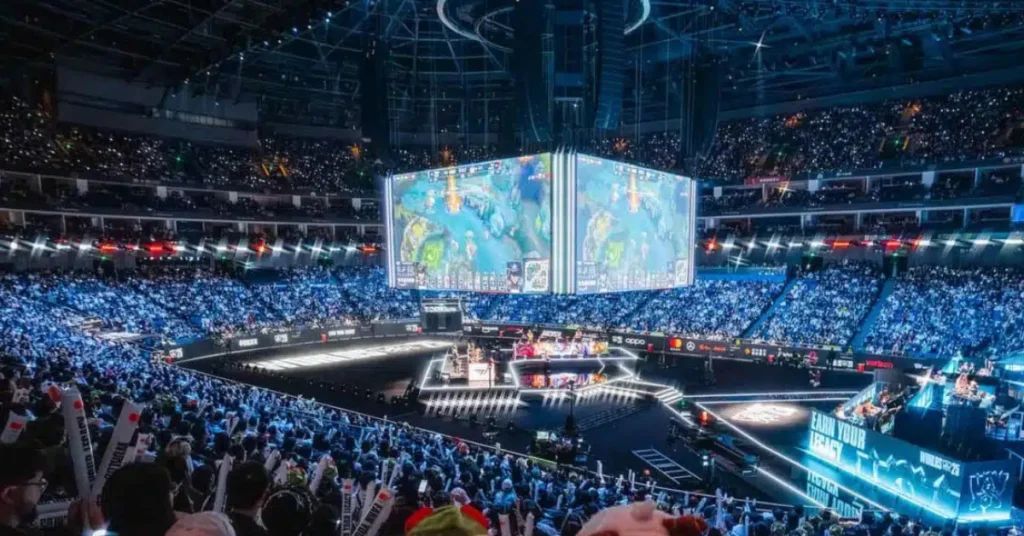
The 2025 World Championship in Chengdu showcased the pinnacle of competitive League of Legends. The tournament ran from October 14 through November 9 across multiple Chinese cities with group stages in Beijing quarterfinals and semifinals in Shanghai and the grand finals at the Dong’an Lake Sports Park in Chengdu. T1 defeated KT Rolster 3-2 in a series that nearly became a historic upset when KT jumped to a 2-1 lead. The championship vindicated T1’s decision to maintain roster continuity with Zeus Oner Faker Gumayusi and Keria staying together for three consecutive seasons
The significance of T1’s three-peat cannot be overstated. No team in League of Legends history had accomplished back-to-back championships with identical rosters. Previous dynasties cycled through personnel changes. T1’s stability combined with superior coaching and player development created something unprecedented. The organization’s willingness to maintain faith in core players despite rough regular seasons paid enormous dividends during the tournament
Faker’s individual achievement transcended statistics. At the pinnacle of his career in his early 30s he won his sixth World Championship title. His previous championships came in 2013 2015 2016 2023 and 2024 spanning over a decade of competitive excellence. Faker accumulated over 350 kills at World Championships more than any player in history. He became the first player to make ten appearances at Worlds demonstrating longevity that defies conventional wisdom about esports athlete careers
Beyond Worlds championships T1 dominated the regional LCK circuit claiming ten total LCK titles. Their 667-333 record across 1000 LCK games represents a 66.7 percent win rate that stands unmatched in competitive League history. This consistency across regular seasons and international tournaments separated T1 from organizations that peaked at specific moments
The 2024 World Championship at London’s O2 Arena featured T1’s 3-2 victory over Bilibili Gaming showcasing their clutch execution under maximum pressure. Faker earned Finals MVP that year as he had done numerous times before. The 2023 championship saw T1 demolish Weibo Gaming 3-0 in a dominant performance that established their trajectory toward the three-peat.
| Year | Opponent | Result | Venue | Finals mvp |
| 2023 | Weibo Gaming | 3-0 | Seoul | T1 |
| 2024 | Bilibili Gaming | 3-2 | London | Faker |
| 2025 | KT Rolster | 3-2 | Chengdu | Gumayusi |
The competitive depth within these championships reflected how rapidly League of Legends meta evolved. The 2023 championship favored T1’s teamfight execution and siege strategy. 2024 forced adaptations to different map control patterns. 2025 tested their ability to overcome early deficits and execute from disadvantaged positions. Maintaining excellence across three distinct meta shifts with the same roster speaks to coaching quality and player versatility.
T1’s organizational structure emphasized long-term development. Rather than panic roster changes after poor performances they maintained belief in core players while making surgical adjustments to support personnel. This stability contrasted sharply with teams that cycled through entire rosters annually chasing hypothetical improvements that rarely materialized.
The broader LCK dominance under T1’s leadership extended to international competition. The 2025 World Championship featured an all-Korean final between T1 and KT Rolster representing the LCK’s fourth consecutive World title and sixth straight international championship. Chinese teams from the LPL that previously competed for dominance found themselves unable to match Korean strategic sophistication and mechanical excellence.
Gumayusi’s emergence as the Finals MVP in 2025 demonstrated how T1’s success wasn’t built around one player. While Faker commanded attention and respect throughout the tournament Gumayusi’s ADC play proved decisive in crucial moments. This distribution of excellence across five positions made T1 difficult to counter and nearly impossible to exploit through targeted bans. If you want to understand how individual player achievements combine with team dynamics to create championship dynasties explore our detailed analysis on T1’s legendary three-time World Championship legacy.
3) Call of duty league and regional competition analysis
The Call of Duty League carved out its own competitive identity within North America’s esports ecosystem through franchise-based regional rivalries and seasonal tournament structures that built dramatic narratives. The 2025 championship season proved that North American dominance in tactical shooters extended beyond Counter-Strike into other competitive titles.
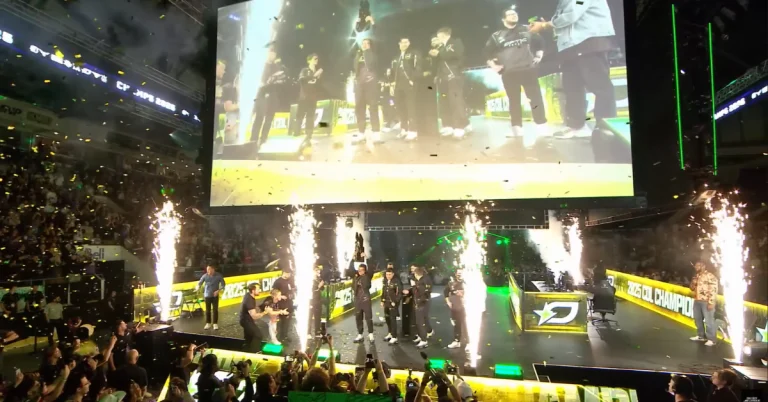
Optic Texas’s back-to-back championship victories in 2024 and 2025 established the franchise as the CDL’s newest dynasty. The 2025 championship took place June 26-29 in Kitchener Ontario marking the first time the CDL championship occurred outside the United States [web::67]. This geographic expansion into Canada reflected the league’s growth and confidence in hosting international-caliber events in secondary markets. Optic defeated Vancouver Surge 5-3 in the grand finals claiming 800,000 dollars in prize earnings.
What made optic’s title run remarkable was overcoming a disastrous regular season. The team finished top-eight at three consecutive majors in January March and April generating serious doubts about their championship viability. Franchise management resisted panic roster overhauls instead making targeted changes. When Kenny was released and replaced by Cesar Bueno the chemistry didn’t improve. The pivotal move came when Mason Mercules Ramsey signed as a rookie having impressed as an amateur filling in for Toronto Ultra
Mercules’s transformation from substitute to championship contributor represented one of 2025’s greatest esports stories. In his first professional season competing against the world’s elite he won a world championship. His mechanical excellence and tactical intelligence revitalized optic’s gameplay across all four game modes. The rookie’s arrival seemed to unlock something in the veteran players around him. Shotzzy and Dashy suddenly found their rhythm while Huke brought championship experience from his 2020 Dallas Empire title.
Shotzzy’s individual achievement reached historic proportions. At just 23 years old he became the youngest three-time Call of Duty world champion in history. His first championship came in 2020 with Dallas Empire his second in 2024 with optic and his third in 2025. Beyond Call of Duty he also held a Halo World Championship title making his esports resume extraordinary for someone still in their early twenties.
The regional dynamics of the CDL reflected North America’s deep competitive talent pool. Toronto Ultra and Vancouver Surge both Canadian franchises made the championship tournament demonstrating how the league’s geographic expansion developed multiple competitive powerhouses. Toronto Ultra’s third-place finish at majors throughout 2025 showed they remained contenders despite falling short at championships. Vancouver Surge’s remarkable loser’s bracket run to the finals captured the imagination of Canadian esports fans watching their homegrown teams compete at the highest level.
| PLAYER | CHAMPIONSHIPS | RINGS TOTAL | 2025 SIGNIFICANCE |
| Shotzzy | 2020, 2024, 2025 | 3 | Youngest 3-time champion |
| Dashy | 2024, 2025 | 2 | Consecutive back-to-back |
| Huke | 2020, 2025 | 2 | Veteran leadership |
| Mercules | 2025 | 1 | Rookie first-year champion |
The CDL’s franchise model created organizational stability that traditional circuit tournaments rarely matched. Teams invested in long-term rosters built around core players rather than annual free agent free-for-alls. Optic’s decision to maintain Shotzzy and Dashy as anchors while finding complementary pieces proved successful. The franchise’s coaching staff led by Damon Karma Barlow earning his fifth championship ring as player and coach understood how to maximize roster potential
Call of Duty’s popularity in North America created a consistent pipeline of talented professionals. 36 percent of avid esports fans in North America actively follow Call of Duty on regular basis. This enthusiast base generates sponsorship opportunities and broadcasting revenue that sustain franchise viability. Unlike esports titles that chase casual audiences Call of Duty built dedicated communities that consumed competitive content regularly.
The tournament format proved spectator friendly. Best-of-five series with clear map rotations created narrative arcs that audiences understood immediately. Unlike MOBA formats where matches could extend past two hours Call of Duty majors moved quickly delivering multiple matches per day and keeping momentum constant. This rapid pacing suited streaming schedules and social media coverage.
Optic Texas’s dominance also reflected individual skill progression. Shotzzy’s SMG plays and positioning decisions improved year over year. Dashy’s willingness to hold difficult angles without fragging created map control that enabled others. The supporting cast of Huke and Mercules provided flexible options that prevented opponents from preparing counter-strategies. Coaching adjustments made between matches kept opponents guessing about rotations and engagement distances.
The championship prize money while substantial compared to most esports lagged behind League of Legends and The International. Optic’s 800,000 dollars as 2025 champions represented significant earnings but less than their revenue from franchise salary and sponsorships. This reality reflected Call of Duty’s regional concentration in North America. Global tournaments featuring multiple regions commanded larger aggregate prize pools. The CDL’s franchise model prioritized sustainable salaries over volatile tournament earnings
Looking forward the CDL targets expanded international competition that would challenge North American dominance and elevate prize pools. As franchises expand geographic footprint and media partnerships grow the championship’s stature should increase accordingly. If you want comprehensive analysis of how regional competition shaped competitive outcomes explore our breakdown of optic Texas’s dominant CDL championship run.
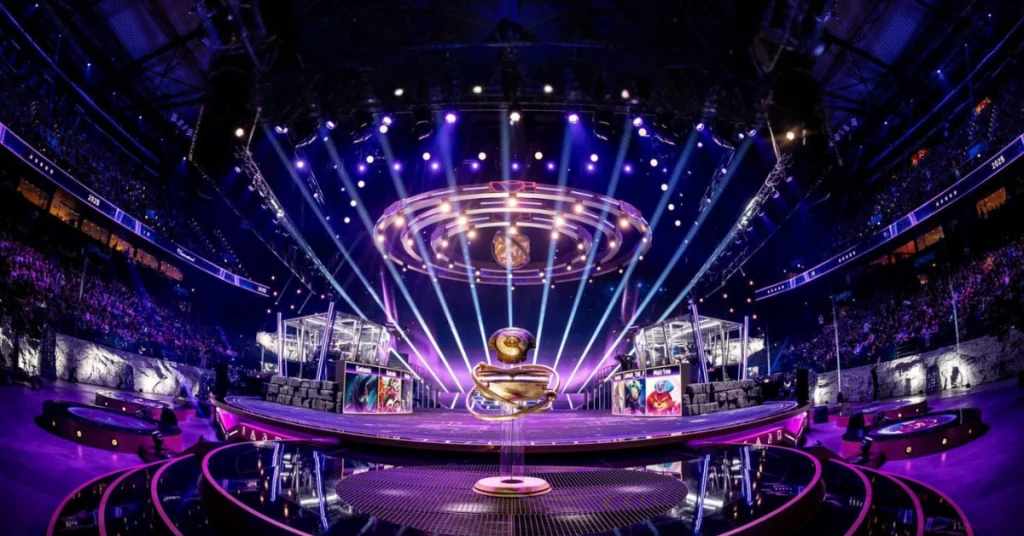
Valorant’s competitive scene matured dramatically during 2025 with NRG’s championship victory in Paris representing the pinnacle of what tactical team-based shooters could achieve in esports. The tournament structure franchise investment and global player development created a competitive ecosystem that rivaled established titles in production quality and competitive depth.
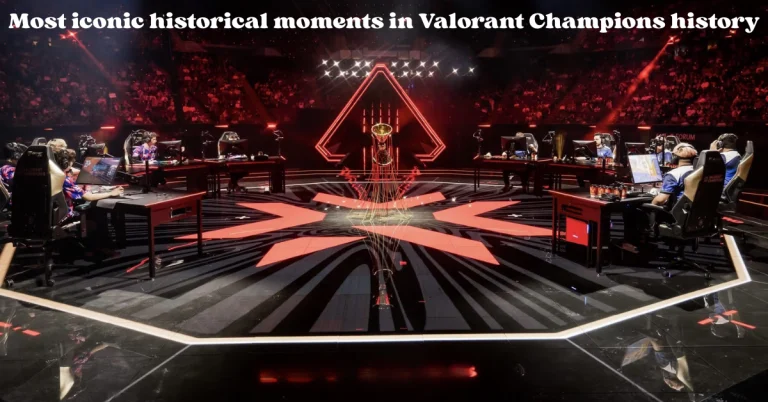
The Valorant Champions 2025 tournament ran September 12 through October 5 in Paris and Évry France featuring 16 elite teams competing for 2.25 million dollars in prize money. NRG defeated Fnatic 3-2 in a grand finals that showcased both teams’ tactical sophistication and mechanical excellence. What separated the victor from the runner-up was NRG’s ability to execute discipline under maximum pressure. After Fnatic won maps two and three to equalize at 2-2 NRG’s collective composure on the deciding Sunset map proved decisive
Ethan Arnold’s achievement transcended individual excellence. He became the first and only player in Valorant history to win two world championships. His first championship came August 26 2023 with Evil Geniuses defeating Paper Rex 3-1 in the Los Angeles finals. That victory established him as an elite player but also preceded organizational chaos where Evil Geniuses players faced contractual disputes preventing roster moves. The transition to NRG in December 2023 transformed his career trajectory.
At just 25 years old Ethan’s two world titles positioned him among esports’ greatest players despite Valorant’s short competitive history. His IGL responsibilities meant he prioritized team success over personal statistics. In the Valorant Champions 2025 finals he earned IGL of the Year honors recognizing his strategic decision-making and mid-round adaptations that orchestrated NRG’s victory
Brock brawk Somerhalder earned the grand finals MVP award becoming one of 2025’s breakout stars. His freshman professional season culminated in championship hardware and recognition. The young Initiator’s mechanical excellence combined with tactical positioning separated him from players relying purely on aim mechanics. His trajectory suggests a lengthy career at the highest level competing alongside proven veterans.
| PLAYER | ROLE | CHAMPIONSHIP HISTORY | 2025 SIGNIFICANCE |
| Ethan | IGL/Support | 2023, 2025 | First 2-time champion |
| Brawk | Initiator | 2025 | Rookie with Finals MVP |
| Mada | Duelist | Regional success | Consistent slaying |
| Skuba | Controller | Regional success | Strategic depth |
| Keiko | Duelist | 2026 addition | Replacing outgoing player |
NRG’s roster composition emphasized versatility and adaptability. Rather than building around isolated star players the organization distributed responsibility across five competent professionals. This depth meant opponents couldn’t exploit single-player matchups. When one player faced difficult circumstances others elevated their performance. The championship proved that cohesion and strategic alignment matter more than raw individual talent concentrated in few hands.
Coach Malkolm bonkar Rench earned Coach of the Year honors validating his contribution to NRG’s success. His ability to prepare a squad with three rookies and guide them to world championship status represented exceptional coaching. The fact that he previously won as a pro player meant he understood the psychological and physical pressures his team faced during tournament runs.
The broader Valorant competitive structure featured regional franchises producing consistent content throughout the year. Unlike games relying solely on major tournaments Valorant’s partnership with Riot Games created sustainable opportunities for professional development. Teams competed in regional leagues throughout spring and summer before converging for international Masters and Champions events.
Fnatic’s path to the 2025 grand finals demonstrated the competitive depth within Valorant. The European organization defeated DRX 3-1 in the lower bracket final showcasing their ability to perform under elimination pressure. Fnatic’s home region advantage at the Paris venue provided intangible benefit but proved insufficient against NRG’s superior execution in the final moments.
Edward Gaming entered as defending champions having won 2024 but fell to Team Liquid in group stage demonstrating the difficulty of maintaining championship-level performance across multiple years. This pattern appeared consistent across esports. Organizations that won previous championships struggled to repeat suggesting that complacency and meta adaptation challenges prevent sustained dominance without exceptional focus.
NRG’s post-championship moves showed organizational sophistication. Rather than dismantle the championship roster they made targeted additions. Keiko replaced an outgoing player while retaining the core that captured the title. This balance between continuity and fresh energy positioned NRG to defend their championship at the 2026 Valorant Champions in Shanghai.
The franchise model implemented by Riot for Valorant created organizational stability that benefited players seeking long-term careers. Unlike circuit-based tournaments where players changed teams constantly Valorant franchises provided guaranteed salaries and multi-year contracts. This security enabled deeper strategic development and longer roster chemistry building.
Valorant’s growth from launch in 2020 to 2025 championship status reflected exceptional game design and esports commitment. The agent-based tactical shooter format attracted players seeking more strategic depth than pure mechanical aim duels. Riot’s willingness to balance agents for competitive integrity while maintaining casual viability created a game that sustained both professional and amateur communities.
The competitive meta evolved constantly throughout 2025. Agent pick rates shifted reflecting patch changes and strategic innovations. Teams that adapted fastest to meta shifts gained advantages during tournament windows. NRG’s coaching staff excelled at translating meta evolution into tactical implementations that opponents couldn’t easily counter.
The tournament production quality elevated Valorant’s prestige. The Accor Arena in Paris provided intimate venue atmosphere with passionate crowds that elevated broadcast energy. Unlike some esports tournaments that feel sterile the Paris event had legitimate sporting energy with fans invested in outcomes.
NRG targets back-to-back championships at 2026 Valorant Champions in Shanghai. No Valorant team has repeated as champions making this achievement their ultimate test. If you want to understand how individual excellence combines with team strategy to produce championship performances explore our detailed analysis of NRG’s dominant Valorant Champions 2025 victory and Ethan Arnold’s historic two-time champion status.
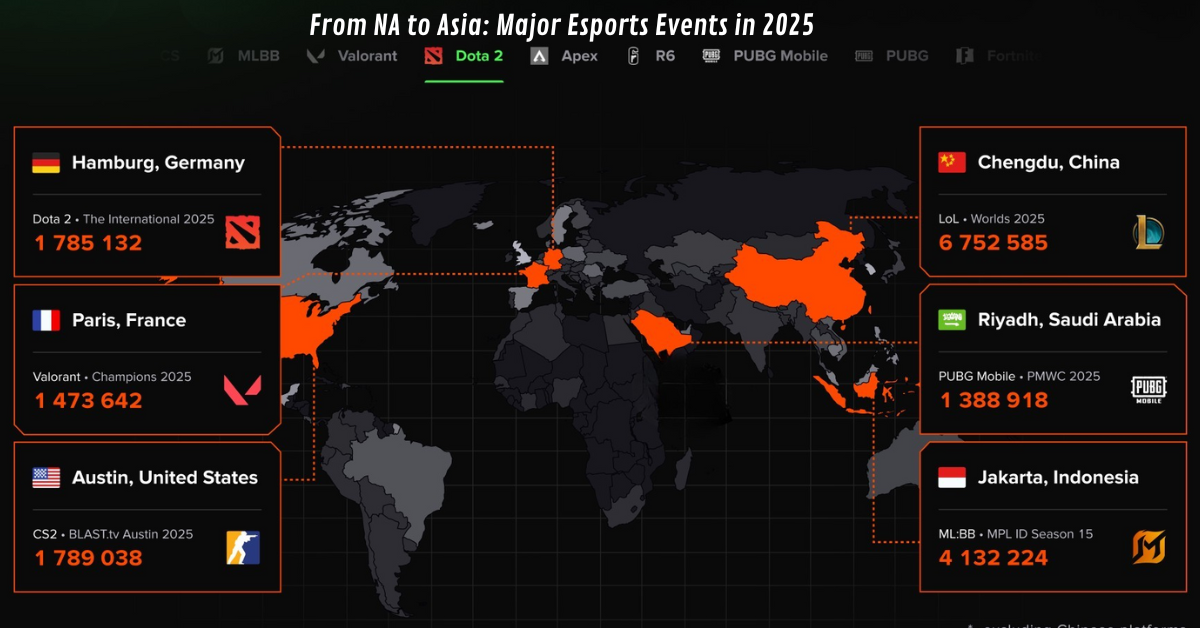
5) Complete calendar of major world esports competitions 2025/2026: all dates, prize pools & venues
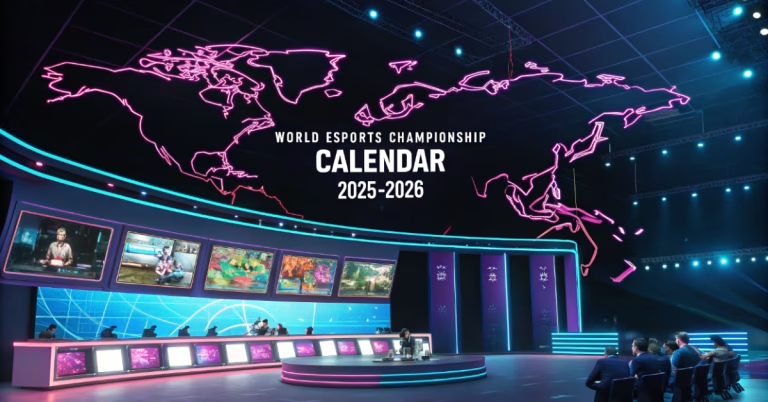
Competitive gaming’s tournament calendar expanded into an intricate web of events spanning continents and demanding constant attention from serious fans and professionals. The 2025 and 2026 schedules represent the most robust competitive years in esports history with prize pools exceeding billions of dollars combined and viewership reaching mainstream numbers.
League of legends world championships dominate the annual calendar as esports’ most prestigious international tournament. The 2025 worlds concluded in chengdu after running from october 14 through november 9 across multiple chinese venues. Group stages occurred in beijing from october 14-25 at the beijing smart esports center. Quarterfinals and semifinals moved to shanghai october 28 through november 2. The grand finals took place in chengdu on november 9.
T1’s championship victory at 2025 worlds claimed approximately 500,000 dollars in prize earnings with the full tournament distributing roughly 2.5 million dollars. The prestige of the championship transcended financial reward. Winning worlds established organizations and players as legitimate world-class competitors.
The 2026 league of legends world championship will break tradition by occurring in the united states for the first time. Allen texas and new york city will share hosting duties representing a significant shift in geographic distribution. Dates typically fall between september and november though 2026 specific dates remain unannounced.
Counter-strike 2’s major championship system distributes significant prize pools across the competitive calendar. Iem katowice 2025 in january distributed 1 million dollars while blast astana and austin majors offered 1.25 million dollars each. The tournament frequency created sustained viewership without dead periods between events.
2026 cs2 tournaments include blast premier bounty season 1 in january with 1.15 million dollars. Iem kraków follows january 28 through february 8 with 1 million dollars. Iem cologne major 2026 represents the year’s flagship event running june 2-21 in cologne germany with 1.25 million dollars. Blast and pgl will host seven combined events throughout 2026.
Valorant’s competitive structure features franchise regional leagues leading to international masters and champions events. The 2026 vct schedule provides full transparency for planning. Kickoff tournaments in multiple regions run january 15 through february 15. Vct masters santiago 2026 occurs february 28 through march 15. Masters london 2026 takes place june 6-21.
Valorant champions 2026 marks the season’s culmination in shanghai china september 24 through october 18. This represents valorant’s return to the chinese market emphasizing riot’s commitment to developing asia-pacific competitive infrastructure. Game changers championship for women’s competitive valorant will occur october or november 2026.
The international 2026 dota 2’s singular marquee championship will take place in shanghai china during august 2026. The tournament will feature 16 qualified teams competing in double-elimination format. The base prize pool starts at 1.6 million dollars with community contributions through in-game cosmetic purchases expanding the total. Historically the international prize pools reach 30-40 million dollars when community contributions are included.
Call of duty league operates on franchise models with city-based teams competing in regular seasons followed by playoff tournaments. The 2025 championship concluded june 26-29 in kitchener ontario. Championship weekend typically occurs in late june annually. 2026 cdl tournament dates remain unannounced but will likely follow similar seasonal timing
| Tournament | 2025 dates | Location | Prize pool |
| Lol worlds | Oct 14 – nov 9 | China | ~$2.5m |
| Iem cologne | June 2-21 | Cologne, germany | $1.25m |
| Vct champions 2026 | Sept 24 – oct 18 | Shanghai | Tba |
| The international 2026 | August | Shanghai | $1.6m+ |
The esports world cup represents a secondary major tournament distributing massive prize pools across multiple titles. The 2025 ewc occurred august 20-24 in riyadh saudi arabia with counter-strike receiving 1.25 million dollars. The 2026 ewc will continue in riyadh maintaining the saudi arabia partnership.
Regional championships determine qualification for international events creating distributed competitive opportunities. League of legends lck championships in korea generated massive viewership as t1 dominated. Lec lpl and lcs championships similarly determined international qualification spots creating competitive value beyond just worlds. Valorant’s regional franchises in emea americas pacific and china produced consistent competitive excellence throughout the year.

Watching major tournaments requires strategic planning based on region and timezone. North american viewers face challenges with asian venues. League of legends worlds 2025 in china created early morning viewing requirements. The 2026 worlds in north america will finally provide convenient timing for the region’s passionate fanbase.
European timezones enjoy advantages for tournaments in cologne london or other european cities. Valorant masters london 2026 in june provides optimal viewing conditions for emea region fans. Shanghai hosted events benefit asian audiences with convenient evening and night viewing times.
Prize pool distribution follows placement-based formulas. Championship victories typically award 400,000 to 500,000 dollars for major tournaments while runner-up finishes provide 250,000 to 300,000 dollars. Counter-strike majors with 1.25 million dollar prize pools award approximately 400,000 dollars to champions with declining amounts for lower placements.
The densest competitive periods occur when multiple majors overlap. June 2026 concentrates valorant masters london with cs major finals creating a weekend of esports excellence. Streaming platforms will feature simultaneous broadcasts of both tournaments.
Professional players earning power increased significantly during 2025. Average salaries rose from 110,000 dollars in 2024 to 138,000 dollars in 2025. Top players in established regions earned multiples of baseline salary with championship bonuses providing additional compensation. Shotzzy’s 800,000 dollars from the optic texas championship win supplemented his already substantial franchise salary.
The geographic distribution across 2025-2026 demonstrates esports’ global ambitions with events spanning every major continent. This ensures international talent development and regional fan engagement. Tournament organizers are already booking 2027 dates suggesting continued growth in prize pools venue availability and production quality.
If you want precise scheduling details and complete tournament calendars for planning your viewing explore our comprehensive breakdown of esports major competitions 2025-2026 with all dates prize pools and venues.
Competitive gaming in 2025 revealed an esports industry that transcended niche entertainment to claim legitimate status alongside traditional sporting events. T1’s three consecutive league of legends world championships established new benchmarks for organizational excellence. Counter-strike 2’s dominance on twitch proved that established hierarchies could be challenged through strategic scheduling. Optic texas’s back-to-back call of duty league championships demonstrated sustained regional excellence. Nrg’s valorant victory made ethan arnold esports’ first two-time world champion.
The streaming ecosystem fragmented into regional preferences where different platforms prioritized different titles. The business fundamentals showed remarkable resilience with the industry generating 1.79 billion dollars in revenue while professional player salaries increased to 138,000 dollars average. Sponsorship deals and media rights accounted for 65 percent of revenue indicating sustainable business models.
The tournament calendar expanded into dense windows of competition with major championships distributing billions in prize money. Younger demographics aged 18-34 comprised 52 percent of the american esports audience with generation z leading globally at 43 percent of viewers. These audience numbers rivaled traditional sports in specific markets.
The infrastructure supporting competitive gaming continued evolving through franchise models professional coaching and broadcast partnerships. Understanding esports in 2025 required recognizing five interconnected dimensions: the games reshaping competitive preferences the historic championships demonstrating sustained excellence regional dynamics creating distinct cultures tournament infrastructure providing distributed opportunities and business fundamentals indicating mainstream economic status.
For anyone wanting to deepen their understanding of how dominant performances translate into legendary status and lasting competitive advantages explore our detailed analysis of the complete esports tournament calendar showing all major championships prize pools and venues for 2025 and 2026 where strategic scheduling and tournament frequency shape competitive outcomes across titles and regions.